
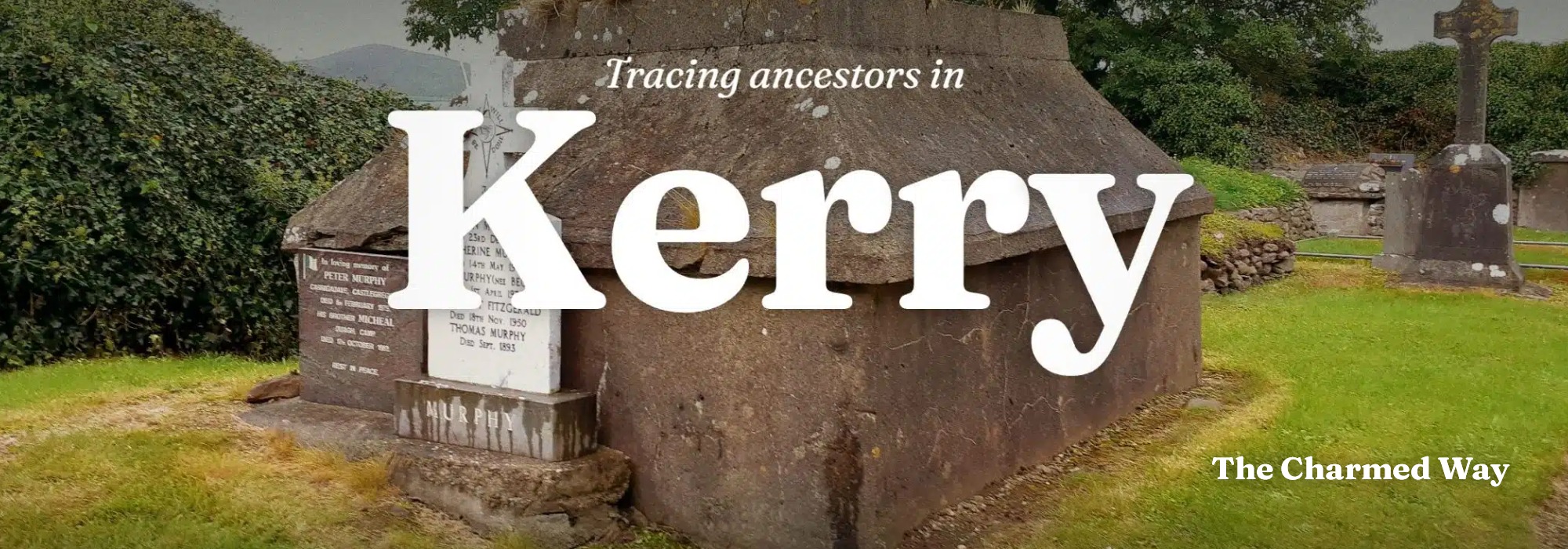
Kerry sent people all over the world. Fishermen from the Iveragh coast, farm families from north Kerry, Irish speakers from the Dingle Peninsula: their descendants now live in Boston, Toronto, Sydney, London and everywhere in between, and many of them eventually want to see where it started.
The good news is that Kerry is one of the better-served counties for family history. Several of its key record sets are free online and transcribed, and the county library holds a large local collection. This guide covers the Kerry-specific sources worth knowing, how to use them, and what a visit to the county can add.
Start with the county’s free online records
Church records on IrishGenealogy.ie
Kerry researchers have an advantage that many counties do not. IrishGenealogy.ie holds free transcripts of baptism and marriage records for the Roman Catholic Diocese of Kerry to around 1900. The diocese also includes parishes in west and north-west County Cork, so it is worth checking if your family lived near the Kerry–Cork border. The site also has transcripts with record images for all surviving nineteenth-century Church of Ireland baptism, marriage and burial records in Kerry.
Because these records are transcribed, you can search by name across the whole diocese rather than browsing parish by parish. Remember that coverage varies: start dates differ between parishes, and some registers have gaps.
Kerry local authority burial records
Kerry County Council has scanned and indexed burial records from 140 local authority burial grounds, free to search at kerrylaburials.ie. Burial registers can confirm a date of death, an age and sometimes an address, and they tell you exactly which graveyard to visit. Older burials, especially before the twentieth century, may not appear in registers at all, so a missing entry does not prove a family was not buried there.
National sources with good Kerry coverage
- Census returns for 1901, 1911 and 1926 on the National Archives website, arranged by townland.
- Civil records of births, marriages and deaths from 1864, also on IrishGenealogy.ie. Kerry’s registration districts followed the Poor Law Unions, such as Killarney, Dingle, Listowel, Cahersiveen and Kenmare.
- Griffith’s Valuation on Ask About Ireland. Munster counties were among the first to be published, so Kerry’s valuation appeared relatively early in the series.
- Tithe Applotment Books from the 1820s and 1830s, free on the National Archives website.
For a fuller explanation of these national sources, see our guide to free Irish genealogy records online.
Kerry Library’s local history and archives
Kerry County Library has a Local History and Archives department at the library headquarters. It holds the archives of Kerry County Council and former town councils such as Killarney and Listowel, along with local newspapers, maps, books and the minute books of the Kerry Poor Law Unions’ Boards of Guardians. Poor Law records can mention people who received relief or entered the workhouse, which makes them a valuable source for families who left little else on paper.
Staff will offer advice on local studies queries, but they are not available to carry out research on behalf of the public, so arrive with your own questions ready. Check opening hours and book ahead before you travel.
Local stories from the 1930s: the Schools’ Collection
Between 1937 and 1939, children in primary schools across the country were asked to write down local folklore, history and traditions from older people in their communities. The results are online at Dúchas.ie, and many Kerry schools took part.
Search for the school nearest your ancestors’ townland. You may find stories about local landlords, holy wells, the Famine, emigration and named families from the area. Even when your own family is not mentioned, it is the closest you will get to hearing how people in that parish talked about their own place.
Kerry’s emigration story
Many Kerry emigrants travelled to Cobh to board transatlantic ships. Cobh, then called Queenstown, was the busiest emigration port in Ireland, and its heritage centre tells the story of the millions who left from its quays.
We cover Cobh in more detail in our guide to Cobh and Irish emigration.
Reading the landscape of a Kerry parish
Kerry’s parishes are very different from one another. North Kerry is gentler farmland. The Iveragh and Beara peninsulas are mountainous, with families scattered along the coast and in the glens. The western end of the Dingle Peninsula, Corca Dhuibhne, is a Gaeltacht where Irish remains a community language, and place names on signs there appear in Irish. If your family came from a Gaeltacht area, their names may appear in Irish forms in some records and in English forms in others.
Understanding that landscape helps you interpret the records. A family listed with a few acres on a mountainside lived very differently from one on a larger holding in the lowlands, and the distance to the parish church or the market town shaped daily life.
Visiting Kerry for family history
Once you have a parish or townland, a visit lets you see the graveyard, the church, the land, and the view your ancestors knew. Some suggestions:
- Combine places by area. Kerry is large and its roads are slow. Group the parishes you want to see so you are not crossing the county repeatedly.
- Visit graveyards in daylight and bring something to note inscriptions. Many older headstones are weathered and easier to read in low, angled light.
- Ask locally, respectfully. A neighbour, a parish office or a local history society may know far more than any database.
- Leave time for the wider area. The same journey can take in the Dingle Peninsula, the Ring of Kerry or Killarney National Park.
The Charmed Way is based on the Dingle Peninsula, and Kerry is home. Our founder’s own family story crosses the Atlantic: a Kerry grandfather and a Galway grandmother met and married in Boston before returning to a farm in Kerry. The Legacy Trail grew from that understanding that a place means more when it belongs to your family’s story.
Questions About Tracing Kerry Ancestors
Are Kerry Catholic parish records online for free?
Yes. Images of registers mostly up to 1880 are on the National Library’s parish register site, and IrishGenealogy.ie has free searchable transcripts for the Diocese of Kerry to around 1900.
Can Kerry Library research my family for me?
Library staff will advise on local studies queries but do not undertake research on behalf of the public. A professional genealogist can take on commissioned research.
My ancestor’s townland name looks different on every record. Why?
Most Kerry townland names are English versions of Irish words, and spellings varied widely in the nineteenth century. Check variations on logainm.ie, and see our explainer on what a townland is.
Which Kerry ports did emigrants leave from?
Many Kerry emigrants travelled to Cobh (then Queenstown) in County Cork.
Bring your Kerry family story
If your research points to Kerry, tell us the names, parishes or townlands you have found. We will look at what can be identified and suggest how to build a private journey around it.
Family roots can lead anywhere on the island, and so can we. The Charmed Way plans private heritage and ancestry tours all over Ireland, combining the places connected with your family with highlights such as the Cliffs of Moher, Connemara, the Ring of Kerry and Cobh.