
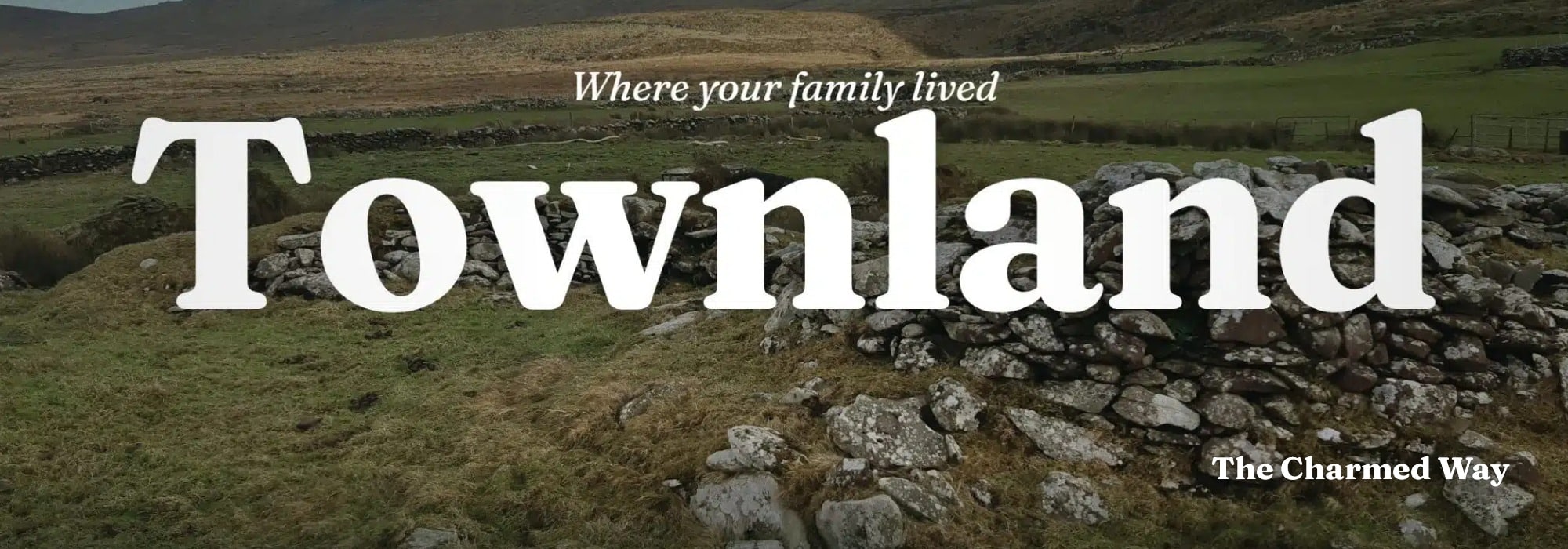
If you have spent any time with Irish family records, you will have met the word townland. It appears on census forms, baptism entries, land valuations and headstones, and it is often the single most useful clue for finding where an ancestor actually lived. Yet many people abroad have never heard of it, and plenty of Irish people use the word without thinking about where it came from.
Here is what a townland is, how it fits into Ireland’s other land divisions, and how to use one when you are tracing your family.
What a townland is
A townland is a small, named unit of land. It is the smallest administrative division in Ireland, and every other territorial division is built up from collections of townlands. Despite the name, a townland is not a town. Most are rural: a few farms, a hillside, a stretch of bog or shore. Some contain no houses at all.
Sizes vary enormously. Townlands range from roughly one acre to around 7,000 acres. There are over 61,000 townlands across the island of Ireland, including uninhabited ones, and around 51,000 in the Republic alone.
The system is far older than the maps that fixed it. Townland names often carry Irish-language words for landscape features or early settlements, such as baile (homestead or settlement), cill (church), dún (fort) or ráth (ringfort). The Ordnance Survey of the 1830s standardised the names and boundaries in English spellings, which is why the same place can appear in several forms across older records.
How townlands fit with parishes, baronies and counties
Irish records use several overlapping divisions, and it helps to know how they nest together:
- Province: Munster, Leinster, Connacht and Ulster.
- County: 32 across the island, 26 in the Republic.
- Barony: an older division used in nineteenth-century records, rarely used today.
- Civil parish: a land division used for census, valuation and tithe records. It does not always match the Catholic parish.
- Townland: the smallest unit, sitting inside a civil parish.
Two other divisions matter for research. Catholic parishes were organised by the Church, often combine or split civil parishes, and are the basis for the parish registers held by the National Library. Poor Law Unions, created by the Poor Law Act of 1838, later became the registration districts for births, marriages and deaths. If you are searching civil records, you are usually searching by registration district, not by townland.
Why a townland matters for family history
Ireland has a limited range of common surnames, and many families reused the same first names over generations. In a single parish you may find several men called John O’Connor born within a few years of each other. The townland is often what separates them.
Townland names appear in many of the records people use most:
- Census returns. The 1901 and 1911 census returns are arranged by townland or street. The 1926 census asked for birthplace including the name of the townland or town, which is especially useful for anyone born in the late nineteenth century.
- Griffith’s Valuation (1847 to 1864), which lists occupiers of land and buildings townland by townland.
- Tithe Applotment Books from the 1820s and 1830s, which the National Archives makes browsable by county, civil parish and townland.
- Parish registers and civil records, where the townland is often written beside a name or address.
Once you have a townland, you can follow it backwards and forwards through these records, see neighbouring families, and often find the same household across several generations.
How to find your ancestor’s townland
If the family does not remember it, work outwards from documents:
- Look at records created abroad. Marriage and death records, obituaries, naturalisation papers and church registers in the country of settlement sometimes give a townland or parish.
- Search the census. If any relatives stayed in Ireland, the 1901 or 1911 census can place the family in a townland.
- Use Griffith’s Valuation to see where a surname appears in a county, then narrow it by first names that recur in your family.
- Check spellings. Search the Placenames Database at logainm.ie or townlands.ie for variations. A name heard by an emigration clerk may not look much like the official spelling.
Be cautious with a single match. If a townland fits one detail but not others, keep it as a possibility rather than a conclusion. Our guide to free Irish genealogy records online explains where each of these sources can be searched, and planning an Irish ancestry trip covers how to turn what you find into a visit.
Visiting a townland today
Standing in your family’s townland can be moving, but it is worth knowing what to expect. The boundaries are rarely signposted. The house your ancestors lived in may be a ruin, rebuilt, or gone entirely. The land is almost always private property, so you will usually be looking from the road, the nearest graveyard or a public viewpoint, unless the landowner invites you in.
What often survives is the shape of the place: the field patterns, the hill behind the farm, the church the family walked to, and the graveyard where they were buried. Local knowledge helps a great deal here. A good guide can find the right turn off a boreen, read the landscape with you and, where it is appropriate, ask a neighbour whether anyone remembers the name.
That is the approach behind The Legacy Trail. We start from the names, parishes and townlands you already have and shape a private route around the places connected with your family.
Questions About Townlands
Is a townland the same as a village?
No. A townland is a unit of land, not a settlement. A village may sit inside one townland or spread across several, and many townlands are entirely rural.
Are townlands still used?
Yes. Townlands remain part of official mapping and many rural addresses still include one. They also carry strong local identity: people often describe where they are from by townland.
Why does my ancestor’s townland have several spellings?
Most townland names are English versions of Irish words, written down by clerks and surveyors who did not always speak Irish. Spellings varied until the Ordnance Survey standardised them, and some continued to vary afterwards.
What if I only know the parish?
A parish is still a good starting point. Census and valuation records for that parish can show which townlands your surname appears in, which narrows the search considerably.
Bring us what you know
If you have a townland, a parish or just a surname and a county, tell us about your family. We will look at what can realistically be identified and suggest how to build a visit around it.
Family roots can lead anywhere on the island, and so can we. The Charmed Way plans private heritage and ancestry tours all over Ireland, combining the places connected with your family with highlights such as the Cliffs of Moher, Connemara, the Ring of Kerry and Cobh.